

How to Tell if a Laundry Pod Is High Quality
May 13, 2026
Leave a message
Why Quality Matters in Laundry Pods for B2B Buyers
For importers, brand owners, and distributors, laundry pods wholesale sourcing is not only about product cost or appearance-it is about ensuring stable performance across large-scale retail and export markets, where small quality variations can quickly become commercial risks.
In B2B supply chains, quality issues rarely appear as isolated cases. They usually repeat across batches and markets, which makes consistency a core requirement rather than an optional advantage.
Typical failure points of low-quality laundry pods include:
- Residue remaining on clothes or inside washing machines after use
- Unstable stain removal performance across different fabrics or cycles
- Packaging damage such as leakage or broken pods during shipping
- Customer complaints related to odor inconsistency or skin discomfort
For buyers in private label laundry pods sourcing, these issues directly affect retailer confidence, return rates, and long-term brand positioning, making formulation stability and production control more important than short-term pricing decisions.


Water-Soluble Film Quality in Laundry Pods Manufacturing
In private label laundry pods sourcing, the water-soluble film (PVA/PVOH) is one of the most critical technical components. For importers and brand owners, it directly determines user experience, product stability, and complaint rate in retail markets.
Unlike packaging or fragrance, film performance is a functional safety factor. Any inconsistency in dissolution or sealing can immediately lead to visible product failure at the end-user level.
Water-Soluble Film Dissolution Performance
A high-quality water-soluble film must dissolve reliably under different real-world conditions, not only in laboratory tests.
It should fully dissolve in:
- Cold water cycles used in energy-saving markets
- Short wash programs (15–30 minutes) common in modern machines
- High-efficiency (HE) washing machines with lower water usage
If dissolution is incomplete, it often indicates:
- Low-grade or inconsistent PVA raw materials
- Unstable film thickness during production
- Poor heat-sealing or forming control in manufacturing
For B2B buyers, incomplete dissolution is not a minor defect-it usually leads to immediate consumer complaints and retailer rejection.
No Residue After Washing Cycle
From a retail perspective, residue is one of the most visible quality failures.
A properly manufactured laundry pod should leave:
- No sticky fragments on fabrics
- No gel-like traces on clothing
- No plastic-like residue inside the drum or corners
Even small remnants can significantly affect consumer trust, especially in premium or private label product lines where expectations are higher.
This is often one of the first issues noticed in household testing, making it a critical acceptance standard for distributors and brand owners.
Stable Performance in Storage and Transport
Beyond washing performance, film quality must also remain stable throughout the supply chain.
High-quality pods should withstand:
- High humidity storage environments in warehouses
- Long-distance sea freight and container shipping cycles
- Temperature fluctuations during cross-border logistics
If pods start to stick together, deform, or leak inside cartons, it typically signals weak process control or insufficient anti-sticking formulation during production.
For importers managing OEM laundry pods manufacturing, this stage is particularly important, as instability here directly increases loss rate during shipping and warehouse handling.

Laundry Pod Formulation System
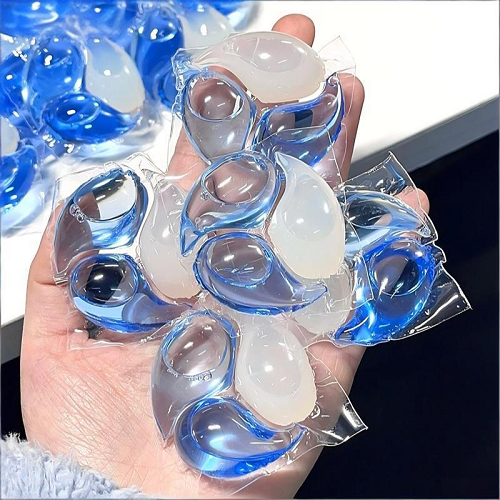
From a formulation standpoint, OEM laundry pods manufacturing is not defined by fragrance or appearance, but by how effectively the enzyme system and surfactant network are engineered to work together under real washing conditions.
In B2B product development, this balance directly determines cleaning consistency across different markets, water types, and machine standards.
Enzyme System as the Core Cleaning Engine
In high-performance formulations, the enzyme system is the functional core that determines how stains are actually broken down at a molecular level.
A typical professional-grade system may include:
- Protease → targets protein-based stains such as sweat, blood, and food residues
- Lipase → breaks down grease, sebum, and body oil buildup
- Amylase → handles starch-related stains from sauces, rice, and processed foods
For private label laundry detergent pods, this enzyme synergy is often what differentiates basic cleaning performance from premium stain removal efficiency. Fragrance or visual appearance does not contribute to actual cleaning power in real usage conditions.
Surfactant Concentration vs. Filler Optimization
Another key factor in laundry pods wholesale formulation is the ratio between active surfactants and non-functional fillers.
Lower-tier products often:
- Increase water or solvent content to reduce cost
- Use fillers to artificially raise product weight
- Reduce active ingredient concentration, weakening cleaning consistency
In contrast, high-quality OEM formulations focus on:
- Higher active surfactant concentration for stronger soil removal
- Controlled reduction of unnecessary solvents and diluents
- Stable cleaning performance even in cold or variable water conditions
For importers and brand owners, this distinction is critical because surfactant efficiency directly affects customer satisfaction, especially in regions with different water hardness levels or washing habits.
In practice, a well-balanced enzyme–surfactant system is what allows a laundry pod to perform consistently across multiple markets rather than only under ideal laboratory conditions.


Fabric Care Performance in Laundry Pod Sourcing
For B2B brands and private label buyers, cleaning efficiency alone is no longer enough. In modern retail environments, especially for private label laundry pods OEM manufacturing, buyers and end consumers increasingly evaluate a deeper question: does this product clean effectively without damaging fabrics over time?
This shift is particularly important for importers and brand owners supplying supermarkets, e-commerce platforms, and fashion-focused retail channels, where garment appearance after multiple washes directly influences repeat purchases.
A well-positioned premium laundry pod is expected to deliver stable fabric care performance across different textile categories and usage conditions.
Anti-Redeosition Performance for Cleaner Appearance
One of the key technical expectations in modern formulations is anti-redeposition performance. This refers to the detergent's ability to prevent loosened dirt from settling back onto fabrics during the wash cycle.
Without this function, garments may still be washed but can gradually appear:
- Dull in overall tone
- Slightly gray after repeated cycles
- Uneven in cleanliness across different fabric areas
For retailers, this is not just a performance issue-it directly impacts perceived product quality on shelf and customer satisfaction after purchase.
Color Protection for Global Retail Standards
Color stability is a critical factor in laundry pods for export markets, especially in regions such as the EU and US where consumer expectations for fabric appearance are high.
A stable formulation helps reduce:
- Fading after multiple wash cycles
- Loss of vibrancy in synthetic and blended fabrics
- Early visual aging of fast-fashion garments
For brands targeting high SKU turnover or fashion retail channels, poor color protection can quickly lead to reduced repurchase rates and weaker brand loyalty.
Fabric-Friendly Formulation as a Purchasing Standard
Modern B2B buyers increasingly prioritize fabric safety as part of product qualification, not just a secondary benefit.
A competitive formulation is typically expected to:
- Avoid harsh bleaching effects on textiles
- Minimize long-term fiber stress or weakening
- Maintain garment integrity after repeated washing cycles
This is especially relevant for mid-to-high-end private label brands, where product positioning depends not only on cleaning performance but also on how well garments are preserved over time.
In practice, fabric care performance has become a key differentiator in supplier evaluation, particularly when comparing wholesale laundry pods suppliers for retail distribution, where long-term product consistency directly affects shelf performance and contract renewal.


Packaging Stability for Laundry Pods
In laundry pods OEM sourcing, packaging is not only a branding element but a critical part of product integrity and landed cost control. For importers, distributors, and private label brands, packaging performance directly determines whether the product arrives market-ready or generates hidden post-shipment losses.
Unlike many household cleaning products, laundry pods are highly sensitive to pressure, humidity, and temperature variation during transport. This makes packaging structure a key factor in supplier evaluation, not an afterthought.
Leak-Proof and Structural Integrity During Transit
A stable laundry pod system must maintain physical integrity throughout the full logistics cycle-from factory loading to final retail distribution.
This includes resistance to:
- Long-distance ocean and air freight movement
- Warehouse stacking pressure and pallet compression
- Seasonal temperature fluctuations during storage and transit
Poor structural stability can lead to pod deformation, film rupture, or moisture-triggered leakage, all of which increase rejection risk at destination markets.
Moisture-Resistant Packaging Systems
Because laundry pods contain water-soluble films, moisture protection is essential to maintain product stability before use.
Common packaging solutions in B2B supply include:
- Multi-layer moisture barrier bags for internal protection
- Sealed HDPE containers for improved humidity resistance
- Reinforced recyclable cartons with inner lining protection for export durability
The goal is not only product protection, but also maintaining consistent appearance and usability across different climate zones and shipping conditions.
Export Compliance and Retail Readiness
For global private label laundry pods manufacturers, packaging must also align with regulatory and retail requirements in target markets.
Key compliance considerations include:
- Child-resistant closure systems where required by regulation
- Multilingual labeling to support cross-border retail placement
- Barcode, SKU, and retail scanning compatibility for logistics integration
In competitive retail environments, packaging that meets compliance standards from the start reduces time-to-market and avoids costly relabeling or repackaging after arrival.
Overall, packaging stability is not a secondary cost factor-it is a core part of supply chain reliability and brand execution in international laundry pods wholesale operations.


Performance Red Flags in Laundry Pods
For importers and private label brands, laundry pods supplier evaluation should always include small-scale sampling before moving into bulk orders. Early testing results often reveal issues that are not visible in product specifications or marketing claims.
In B2B procurement, performance problems are rarely isolated incidents. They usually indicate deeper formulation or manufacturing instability that will become more obvious once the product enters different markets or usage conditions.
Common performance red flags include:
- Pods that only dissolve fully in hot water, showing weak low-temperature performance
- Sticky residue remaining on fabrics or inside washing machines after cycles
- Inconsistent pod size, sealing issues, or leakage during storage and transport
- Overly strong fragrance that appears to compensate for weak cleaning performance
- Poor results in cold-water or energy-efficient washing environments
- Early-stage complaints emerging from pilot or trial batches
From a sourcing perspective, even a single red flag during sampling should not be overlooked, as it often indicates unstable production control, inconsistent raw material quality, or a cost-driven formulation approach that prioritizes appearance over real performance. For buyers working with OEM laundry pods manufacturers, these signals are key indicators of whether the supplier can maintain consistent quality across different batches and international market conditions.


What Defines a High-Quality Laundry Pod Supplier
A reliable laundry pods OEM supplier is not simply a production site-it functions more like a controlled manufacturing system where formulation stability, quality assurance, and export adaptability work together.
For B2B buyers, especially brands entering multiple markets, supplier capability directly determines whether the product can maintain consistent performance after scaling.
In practical terms, strong suppliers are usually defined by a few core technical and operational capabilities:
- Controlled sourcing of key raw materials such as PVA film, enzyme systems, and surfactant blends
- Strict batch-to-batch consistency management to avoid performance fluctuation between shipments
- Verified cold-water performance to ensure effectiveness across different regional washing habits
- Multi-market formulation testing to adapt to variations in water hardness, temperature, and machine types
- Flexible private label laundry pods customization for packaging, fragrance, and concentration levels
From a procurement perspective, these factors are more important than surface-level specifications like packaging design or unit cost, because they determine whether the product can scale reliably across different retail environments.
In most cases, long-term brand performance in the laundry category is not built at the marketing stage, but at the supplier selection stage-where formulation control and production discipline define how stable the final product will be in the market.

How Youming Supports B2B Laundry Pod Development
At Youming, we focus on scalable OEM laundry pod manufacturing for global brands, private label owners, and distributors who need stable performance across different markets and retail environments.
Our development system is built to support not only production volume, but also consistency, export adaptability, and long-term brand reliability in the laundry pods wholesale supply chain.
Stable Dissolving Technology for Different Washing Conditions
One of the key challenges in global markets is variation in washing environments, especially water temperature and machine types.
Our formulation is designed to ensure consistent dissolving performance in:
- Cold water cycles
- Short or quick wash programs
- High-efficiency (HE) washing machines
This helps reduce issues such as incomplete film breakdown or detergent residue, which are common reasons for customer complaints in international distribution.
Enzyme-Based Cleaning System for Real-World Stain Performance
Instead of relying only on surface-level cleaning agents, our system uses an enzyme-driven approach to improve stain removal efficiency across everyday use scenarios.
It is developed to support:
- Grease and oil breakdown from kitchen use
- Protein-based stains such as sweat or food residue
- General fabric care in mixed household laundry loads
This structure helps maintain consistent cleaning performance even when end users follow different washing habits in different regions.
Export-Ready Private Label and Scaling Support
Beyond formulation, we also provide full OEM and private label support for international buyers who need to scale efficiently.
Our services include:
- Custom formula development based on target market requirements
- Packaging adaptation for different retail standards and compliance needs
- Scalable bulk production for distributors and brand expansion
For brands entering or expanding in the laundry care category, product stability is not just a technical requirement-it is the basis for repeat orders, retail acceptance, and long-term partnership growth.


FAQ
Q1: What is the most important quality factor in laundry pods?
The most critical factor is stable water-soluble film performance that ensures complete dissolution in real washing conditions.
Q2: Why do some pods leave residue?
Residue is usually caused by low-quality film materials, inconsistent compression, or improper sealing during production.
Q3: Are enzyme-based pods better for B2B brands?
Yes, because enzyme systems improve real stain removal efficiency and support more consistent end-user performance, which helps strengthen repeat purchase rates.
Q4: What should importers test before ordering bulk?
Importers should test dissolution in cold water, residue on different fabrics, enzyme-based stain removal performance, and packaging durability during transport simulation.
Final Insight
In the global laundry care market, product quality is ultimately defined by three core factors: dissolution stability, consistent cleaning performance, and reliable supply chain execution. Brands that can control these fundamentals are better positioned to achieve long-term stability and compete effectively in both retail and private label markets.