

5 Chamber vs 3 Chamber Laundry Pods: Which Format Fits Your Product Line?
Sep 30, 2026
Leave a message

Introduction
Choosing between 3-chamber and 5-chamber laundry pods is not simply a question of how many compartments a pod has. For brands, importers, and distributors developing a laundry detergent product, the chamber configuration can affect formulation design, pod weight, manufacturing complexity, product positioning, and overall cost.
A 3-chamber pod can provide a practical format for mainstream laundry products, while a 5-chamber configuration offers more flexibility when specific ingredients or functions need to be separated. However, adding chambers does not automatically make a pod more effective. The right choice depends on the formula, dosage, target market, fragrance profile, packaging, and retail positioning you are developing.
For buyers comparing laundry pods from different manufacturers, the more useful question is therefore not "Which pod has more chambers?" but "Which chamber configuration supports the product I want to bring to market?"
In this guide, we compare 3-chamber and 5-chamber laundry pods from a sourcing and product-development perspective, covering formulation, performance, manufacturing considerations, customization, documentation, and supplier evaluation. The goal is to help B2B buyers identify the format that fits their product strategy before moving from samples to bulk production.


What Actually Sits Inside a Multi-Chamber Laundry Pod?
The main purpose of a multi-chamber laundry pod is to keep different liquid components separated until the pod is added to the wash. This gives formulators more flexibility when certain ingredients are not ideal to combine in the same solution during storage.
A 3-chamber pod and a 5-chamber pod do not necessarily contain completely different types of detergent. The difference is mainly in how the formulation is divided between the chambers. Depending on the product design, separate chambers may be used for detergent ingredients, enzymes, builders, boosters, fragrance, or other functional components.
This means chamber count should be considered together with the formula inside the pod. A five-chamber design does not automatically deliver better cleaning performance than a three-chamber design. What matters is whether the additional separation serves a clear formulation or product-positioning purpose.
What Can Change When You Add More Chambers?
For a laundry detergent pod manufacturer, increasing the number of chambers can create more options for formula development, but it also adds another layer of production and quality-control requirements.
The development process may need to consider:
- Formula compatibility: Certain ingredients may benefit from being kept separate during storage.
- Pod weight and dosage: The total fill weight needs to match the intended wash load and formula concentration.
- Fragrance: Fragrance selection and loading can be adjusted according to the target product and market.
- Chamber configuration: Different chamber layouts can support different formula combinations and visual designs.
- Film performance: The water-soluble film must maintain its integrity during filling, packing, storage, and transport while dissolving appropriately during use.
- Production consistency: Each chamber needs accurate filling and sealing to maintain the intended product specification.
For private-label and OEM projects, these variables can be developed together rather than choosing a chamber count first and fitting the formula around it.
What Should B2B Buyers Ask a Manufacturer?
Instead of asking only whether a supplier offers 3-chamber or 5-chamber laundry pods, buyers should ask how the chamber configuration is connected to the actual product specification.
Useful questions include:
- What is the recommended pod weight for the target wash load?
- Which ingredients or functional components are separated between chambers?
- Can the formula, fragrance, and pod weight be customized?
- What film specification is used for the pod?
- How is filling accuracy controlled across multiple chambers?
- What testing is carried out before bulk production?
- Can the manufacturer provide product specifications, SDS, COA, and relevant compliance documentation?
These questions give buyers a clearer view of the product than chamber count alone.
For an OEM laundry pod project, the chamber configuration can be developed around the formula, dosage, fragrance, packaging, and target market. The objective is not simply to add more chambers, but to create a pod specification that can be manufactured consistently and positioned appropriately for the intended market.

How Do 3-Chamber and 5-Chamber Laundry Pods Compare?
Once the chamber structure is understood, the next step is to compare the two formats from a product-development and sourcing perspective.
For B2B buyers, chamber count is only one part of the decision. The more useful comparison covers formulation flexibility, dosage, manufacturing complexity, product positioning, customization, and quality-control requirements.
3-Chamber vs 5-Chamber Laundry Pods
|
Buyer Consideration |
3-Chamber Pods |
5-Chamber Pods |
|
Formulation flexibility |
Suitable for formulations that can be effectively divided across three chambers |
Provides more separation options when the formulation requires additional compartmentalization |
|
Formula customization |
Can support customized formulas, fragrances, weights, and chamber combinations |
Offers additional flexibility for more complex formula designs |
|
Pod weight |
Depends on formula concentration, dosage, and target wash load |
Depends on the same factors and should be developed around the final formula |
|
Manufacturing complexity |
Generally simpler chamber filling and production control |
More filling and quality-control variables need to be managed |
|
Product positioning |
Can be developed for mainstream, value, or differentiated products |
Can support premium or more function-focused product concepts when the formulation justifies it |
|
Customization potential |
Suitable for many private-label and OEM projects |
Useful when a project requires additional formulation separation or a more complex pod structure |
|
Production considerations |
Fewer chambers can simplify filling and consistency control |
More chambers require accurate filling, sealing, and chamber-to-chamber consistency |
|
Best evaluated by |
Formula requirements, dosage, cost target, and market positioning |
Formula requirements, added functionality, product positioning, and manufacturing feasibility |
The table highlights an important point: there is no fixed specification that makes every 5-chamber pod better than every 3-chamber pod. The final product depends on the formula, raw materials, film, dosage, production process, and performance requirements.


When Does a 5-Chamber Structure Make Sense?
A 5-chamber configuration can be useful when a product requires more separation between different liquid components or when the formulation has specific compatibility considerations.
For example, a manufacturer may develop separate chambers for different functional components rather than combining everything into a single liquid system. The exact configuration should be determined during formulation development rather than treated as a standard recipe.
This is particularly relevant for private-label products that need a more specific formula, fragrance profile, dosage, or product concept. In these cases, the additional chambers can be part of the product design rather than simply a visual feature on the finished pod.
However, more chambers also mean more production variables. Filling accuracy, sealing, film performance, and quality control become increasingly important as the pod structure becomes more complex.
When Is a 3-Chamber Structure More Practical?
A 3-chamber configuration can be a practical choice when the required formula can be effectively separated into three components without needing additional compartments.
For buyers targeting mainstream laundry products or larger-volume production, a simpler chamber structure may also make it easier to balance formula requirements, manufacturing complexity, product cost, and production scalability.
The key is to establish the formula and product specification first, then select the chamber configuration that supports them.
What Should Buyers Compare Before Requesting a Quote?
Instead of comparing suppliers on chamber count alone, ask each manufacturer to quote against the same product specification.
At minimum, define:
- Pod weight and dosage
- Formula requirements
- Fragrance
- Number and function of chambers
- Water-soluble film specification
- Packaging format and pack count
- Target market
- Required documentation and testing
- Expected order volume
This makes supplier quotations much easier to compare. A lower unit price is not necessarily a lower-cost product if the formula, dosage, packaging, or specifications are different.
For OEM and private-label laundry pods, the most useful comparison is therefore not simply 3 chambers versus 5 chambers. It is whether the proposed pod structure can deliver the required formula, product experience, compliance documentation, and production consistency at the intended commercial scale.

What Can Additional Chambers Actually Change?
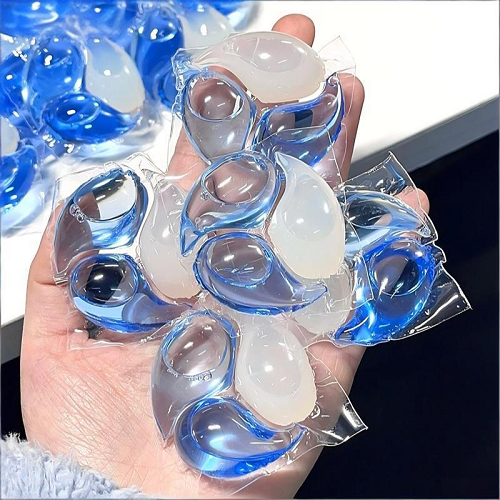
The main potential benefit of adding chambers is greater separation between formulation components. This can give product developers more options when certain ingredients need to be kept apart during storage or when a formula is designed around several functional components.
For example, enzymes, boosters, fragrances, surfactants, or other ingredients may be assigned to different chambers depending on the formulation. The exact arrangement is product-specific, so chamber count alone should not be used as a measure of cleaning performance.
A 5-chamber structure can therefore make sense when the additional separation solves a specific formulation requirement or supports a product concept that would be difficult to achieve with fewer chambers.
More Chambers Also Mean More Production Variables
Additional chambers do not come without trade-offs.
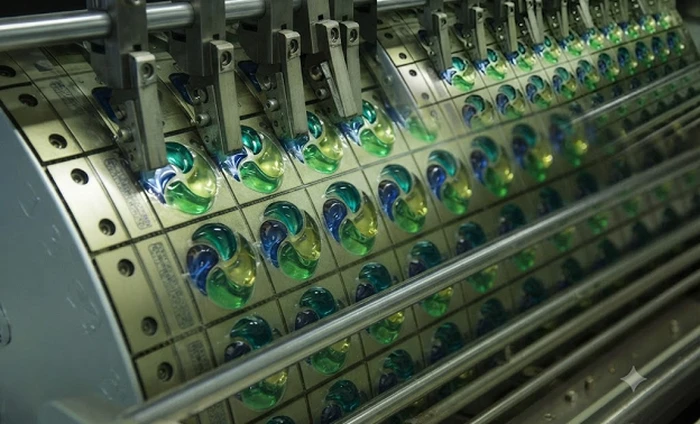
A more complex pod structure requires manufacturers to control more filling points, chamber volumes, sealing areas, and formulation interfaces. The production process therefore needs to maintain consistency across the complete pod rather than simply achieving the correct total fill weight.
For buyers, this makes several quality-control points particularly important:
- Filling accuracy: Each chamber needs to receive the intended amount of formulation.
- Seal integrity: The pod structure must remain intact during filling, packing, handling, and transport.
- Film compatibility: The water-soluble film must be suitable for the formulation and intended storage conditions.
- Formula stability: Components should remain stable throughout the expected shelf life.
- Production consistency: The finished pods should maintain consistent weight, appearance, chamber structure, and performance from batch to batch.
This is why a more complex pod should be evaluated as a complete product specification rather than simply as a higher chamber count.
When a Simpler Structure May Be the Better Choice
If a formula can achieve its intended cleaning and product-positioning goals with three chambers, adding two more compartments may not provide enough commercial value to justify the additional manufacturing complexity.
For a mainstream or high-volume product, buyers may instead prioritize a balanced combination of:
- formula performance,
- target dosage,
- product cost,
- production consistency,
- packaging requirements, and
- order volume.
In contrast, a more complex chamber configuration may be appropriate when the product requires additional formulation separation or when the brand has a clear reason to develop a differentiated pod format.
The decision should therefore start with the formula and product requirements, not with the number of chambers.

Which Laundry Pod Format Fits Your Product Strategy?
For a private-label laundry brand, importer, or distributor, the choice between 3-chamber and 5-chamber laundry pods should be based on the complete product strategy rather than chamber count alone.
The target retail position, formula requirements, expected order volume, dosage, packaging, and level of customization all affect whether a simpler or more complex pod structure makes sense. A laundry pod manufacturer should be able to evaluate these factors together before recommending a final configuration.
For Mainstream and High-Volume Laundry Products
A 3-chamber structure can be a practical option when the formula can achieve its intended performance without additional separation between components. This can make the product easier to develop around a defined dosage, packaging format, and production volume.
For buyers sourcing wholesale laundry pods for mainstream retail or distribution, the focus is often on maintaining a consistent product specification while keeping the manufacturing process scalable. A 3-chamber pod can provide sufficient flexibility for customized formula, fragrance, pod weight, and packaging without requiring a more complex chamber structure.
This does not mean that 3-chamber pods are inherently lower quality. The final product still depends on the formula, raw materials, dosage, film, production controls, and testing behind the pod.
For More Customized or Differentiated Products
A 5-chamber structure may be worth considering when the product concept requires additional separation between formulation components or when the brand has a specific reason to develop a more complex pod format.
For an OEM laundry pod project, this can be relevant when the buyer wants to develop a more specific combination of formula, fragrance, dosage, or functional ingredients. The additional chambers should have a clear purpose within the product design rather than being added simply to create a more premium-looking pod.
For brands building a differentiated private-label laundry detergent pods range, the chamber structure can therefore be one part of the product proposition alongside formula concentration, fragrance, packaging, visual appearance, and market positioning.


What Does the Choice Mean for Your Product Cost?
The cost difference between 3-chamber and 5-chamber pods cannot be determined from chamber count alone.
A supplier quotation may be affected by the total pod weight, formula composition, raw material selection, film specification, packaging, order volume, production requirements, and customization level. A 5-chamber pod may involve a more complex filling process, but the actual cost impact needs to be evaluated against the complete product specification.
For this reason, B2B buyers should avoid comparing only the quoted price per pod. When requesting quotes from a laundry pod manufacturer, provide the same formula requirements, pod weight, packaging, order quantity, and target market information to each supplier. This creates a more meaningful comparison between offers.
Should You Develop Both Formats?
For brands with more than one product position, developing both a 3-chamber and a 5-chamber SKU can be considered as part of a broader product portfolio.
For example, a brand may use a simpler configuration for a mainstream laundry detergent pod and develop a more customized configuration for a differentiated range. Whether this approach makes commercial sense depends on expected volume, market demand, packaging requirements, and the additional development and production work involved.
Working with one OEM/ODM laundry pod manufacturer for multiple configurations can also simplify product development and supplier coordination, particularly when the buyer needs consistent documentation, packaging development, formula customization, and production support across several SKUs.
A Practical Decision Framework for B2B Buyers
- Start with the formula, not the chamber count. Identify which ingredients need to be separated and what cleaning, fragrance, or functional goals the product needs to achieve. The chamber configuration should follow these requirements.
- Consider dosage, positioning, and production volume together. Pod weight, formula concentration, target market, MOQ, and manufacturing capability all affect whether a 3-chamber or 5-chamber format is practical for the product.
- Compare complete product specifications, not unit prices alone. When comparing quotes from a laundry pod manufacturer, review the formula, pod weight, film, packaging, documentation, customization, and order volume together.

What Compliance & Safety Documents Should a Laundry Pod Manufacturer Provide?
For cross-border orders, B2B buyers should confirm the required documentation before moving from samples to bulk production. The exact requirements depend on the formula, packaging, and destination market, so compliance should be reviewed against the finished product rather than assumed from the pod format alone.
Key Documents Buyers Should Request
- SDS and product information: The manufacturer should provide an up-to-date SDS and relevant product information based on the final formula and its intended market.
- Batch-level quality documents: A COA can be used to verify agreed product specifications for a production batch. Buyers should confirm which parameters are included before placing a bulk order.
- Market-specific compliance documentation: Requirements vary by destination. For EU markets, detergent requirements cover areas such as biodegradability, ingredient information, and consumer labelling, while chemical classification and labelling requirements may also apply depending on the formulation. The EU has also adopted Regulation (EU) 2026/405, which will replace Regulation (EC) No 648/2004 from 23 September 2029, subject to its transitional provisions.
- Packaging and safety requirements: Laundry detergent pods in soluble packaging may be subject to additional packaging and safety requirements in the destination market. For example, EU rules include specific requirements for certain soluble-packaged consumer laundry detergents, including outer packaging and child-safety provisions. The U.S. Poison Prevention Packaging Act also establishes child-resistant packaging requirements for covered household substances.
What Buyers Should Confirm Before Production
Before approving a custom laundry detergent pods project, confirm that the manufacturer can provide the documentation required for your destination market and that the documents correspond to the final formula, packaging, and product specification.
For OEM and private-label orders, it is also useful to establish in advance which documents will be supplied for samples and for each production batch. This helps avoid documentation gaps after production or during import procedures.

How to Evaluate a Laundry Pod Manufacturer Before Placing an Order
Choosing between 3-chamber and 5-chamber laundry pods is only part of the sourcing decision. The manufacturer also needs to show that the selected formula, pod structure, film, packaging, and production process can be delivered consistently at your target volume.
Instead of comparing chamber count alone, evaluate the supplier against the complete product specification.
What Should B2B Buyers Check?
|
Evaluation Area |
What to Confirm |
|
Formula & Product Specification |
Confirm the formula, pod weight, chamber configuration, fragrance, film, and packaging are clearly defined before production. |
|
Sample Testing |
Test the actual sample for cleaning performance, dissolution, fragrance, appearance, and packaging before approving bulk production. |
|
Customization Capability |
If you need custom laundry detergent pods, confirm whether the manufacturer can adjust formula, fragrance, pod weight, chamber structure, and packaging to your requirements. |
|
Quality Control |
Ask how filling accuracy, sealing, film handling, and finished-product inspection are controlled during production. |
|
Documentation |
Confirm which SDS, COA, product specifications, test reports, and market-specific compliance documents can be provided for the final product. |
|
MOQ & Production Terms |
Make sure MOQ, sample requirements, lead time, packaging options, and production terms are clearly defined before placing the order. |
|
Manufacturing Experience |
Look for a supplier with relevant experience in laundry pods and the equipment and production capabilities needed for your selected pod structure. |
What Should Happen Before Bulk Production?
A reliable sourcing process should move from product requirements → sample development → testing → specification approval → bulk production.
For OEM and private-label laundry pods, the final specification should be agreed before production rather than changing key details after the order is placed. This is particularly important when the project involves a customized formula, fragrance, pod weight, or multi-chamber structure.
A capable laundry pod manufacturer should be able to explain not only what pod format it can produce, but also why that structure fits the formula and how the finished product will be controlled during production.

FAQ
Are 5-chamber laundry pods better than 3-chamber pods?
Not necessarily. A 5-chamber structure provides more separation options, while performance depends on the formula, dosage, ingredients, film, and testing.
Are 5-chamber laundry pods more expensive?
They can be, depending on the formula, pod weight, production process, packaging, and order volume. Compare complete product specifications rather than chamber count alone.
Can I customize private-label laundry pods?
Yes. Depending on the manufacturer, OEM and private-label projects can include custom formula, fragrance, pod weight, chamber configuration, and packaging.
What documents should I request before placing an order?
Depending on the destination market, buyers may need SDS, COA, product specifications, test reports, and other relevant compliance documents.
3-Chamber or 5-Chamber: Start With the Product, Not the Chamber Count
The choice between 3-chamber and 5-chamber laundry pods should start with the formula, dosage, target market, and product positioning-not simply the number of compartments.
A 3-chamber structure can support many mainstream and high-volume products, while a 5-chamber structure can provide additional formulation flexibility when a product requires more separation between components. For B2B buyers, the final decision should also consider customization, packaging, production consistency, documentation, and order volume.
For brands developing custom laundry detergent pods, working with an experienced laundry pod manufacturer can help connect these requirements from formula development through sample testing and bulk production.
Develop Your Custom Laundry Pods With Youming Group
Youming Group supports OEM and private-label laundry pod projects with customization across formula, fragrance, pod weight, chamber configuration, and packaging. Our manufacturing and product-development capabilities allow buyers to develop laundry pods around their target market and product requirements.
Request a Sample or Contact Youming Group to discuss your next private-label laundry pod project.