

History of Laundry Detergent Pods
May 18, 2026
Leave a message

How Laundry Pods Changed Modern Laundry Care
Laundry detergent pods have become a popular alternative to traditional powders and liquids thanks to their convenience, pre-measured dosing, and compact design. However, modern pods were developed through years of experimentation, with early products facing issues such as poor dissolving performance, leakage, and packaging instability.
As demand grew for faster and simpler laundry solutions, manufacturers increasingly shifted toward concentrated single-dose formats, helping pods become a major category in modern fabric care.
This article covers:
- The early history of detergent pods
- Why early unit-dose products failed
- How water-soluble film changed the market
- Safety and sustainability concerns
- The future of laundry pod development


Before Laundry Pods Became Popular
Before laundry pods entered the market, powder detergents dominated household laundry care for decades. In the mid-20th century, synthetic detergent powders became widely adopted because they offered stronger cleaning performance and worked better with automatic washing machines than traditional soap bars.
Still, powders created several common consumer frustrations:
- Poor dissolving in cold water
- Residue left on fabrics
- Clumping in humid conditions
- Messy measuring and spills
By the 1980s and 1990s, liquid detergents began gaining popularity because they dissolved more easily and performed better for stain treatment and cold-water washing. However, liquids introduced their own convenience issues.
Common complaints included:
- Over-pouring detergent
- Heavy and bulky bottles
- Sticky caps and spills
- Wasted product left inside containers
As consumer demand shifted toward easier and more controlled laundry solutions, manufacturers began exploring single-dose detergent systems, laying the foundation for modern laundry pods.


The First Attempt at Single-Dose Laundry Detergent
Although laundry pods feel like a modern invention, the idea of pre-measured detergent actually began decades ago. Early manufacturers were already trying to create easier and less messy alternatives to traditional detergent powders.
The Introduction of Salvo Tablets
In 1961, Procter & Gamble introduced Salvo detergent tablets, one of the earliest single-dose laundry products. Instead of loose detergent powder, consumers used compressed tablets designed to simplify laundry routines and reduce over-pouring.
The concept aimed to solve several common problems:
- Using too much detergent
- Product waste
- Messy measuring
- Difficult storage and handling
At the time, however, detergent technology was still too limited to make the system work reliably.
Why Early Detergent Tablets Failed
The biggest issue was dissolving performance. The tablets often failed to fully break down during wash cycles, especially in cold water, which became increasingly common in household laundry.
Consumers frequently experienced:
- Undissolved detergent residue
- White marks on clothing
- Incomplete stain removal
- Fabric spotting problems
These limitations showed that compressed detergent tablets were not a practical long-term solution. Manufacturers eventually realized they needed a different delivery system that could better protect detergent formulas while still dissolving quickly and consistently during washing.


The Breakthrough: Water-Soluble PVA Film
The development of laundry detergent pods fundamentally changed when packaging technology improved, especially with the introduction of water-soluble films that made single-dose detergents commercially viable.
What Is PVA Film?
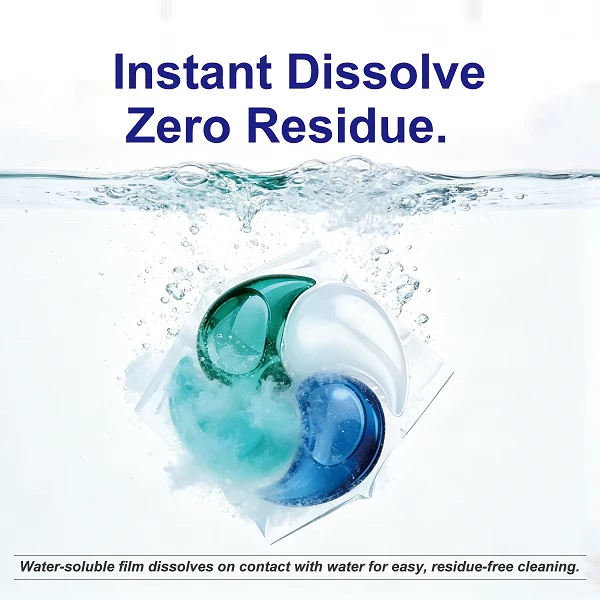
PVA (polyvinyl alcohol) is a water-soluble polymer used to create film packaging that stays stable during storage but dissolves completely when it comes into contact with water. Compared with traditional plastic packaging, it enables controlled release of liquid detergent during the wash cycle.
Why PVA Film Changed the Industry
The shift to PVA film solved several long-standing limitations of early detergent tablets and enabled a more reliable pod system.
·Consistent dissolving performance
Works effectively in both warm and cold wash cycles, improving usability across different regions and machines.
·Improved formula stability
Allows concentrated liquid detergents to be sealed securely, reducing leakage and moisture exposure during storage and transport.
·Enabled advanced product design
Supports more complex detergent systems, including enzyme-based formulas, multi-chamber pods, and highly concentrated cleaning solutions.


The European Liquitab Era
Before laundry pods became a global household product, early unit-dose detergent formats first gained traction in Europe in the late 1990s and early 2000s. These were commonly referred to as liquitabs or single-dose capsules.
They were especially well received in urban European households, where limited storage space, smaller washing machines, and a preference for simpler laundry routines made pre-measured detergent formats more practical.
- Early adoption of liquitabs and unit-dose capsules in Europe
- Strong demand in compact urban living environments
- Convenience and reduced handling were key drivers
This early acceptance showed that consumers were willing to shift away from traditional detergent formats when convenience and ease of use were clearly improved.

Why Laundry Pods Became So Popular in the 2010s
Although unit-dose laundry products existed earlier, the global adoption of pods accelerated in the 2010s as both consumer behavior and manufacturing priorities shifted.
Convenience became the main driver
Households increasingly preferred products that simplified daily routines and reduced handling steps. Laundry pods matched this change by removing manual dosing and reducing mess during use.
- No need to measure detergent each time
- Cleaner storage and handling
- Faster laundry preparation
- More consistent dosing results
Growth of concentrated detergent formats
At the same time, the industry was moving toward more concentrated formulations to reduce shipping costs and improve logistics efficiency. Pods naturally fit this direction due to their compact structure and reduced water content.
- Lower transportation weight
- Smaller packaging volume
- Improved storage efficiency
- Better cost control in bulk shipping
Multi-chamber design improved performance
A key technical improvement was the development of multi-compartment pod structures, which separated active ingredients until the wash cycle began. This helped improve stability and allowed better control over cleaning performance.
- Separation of surfactants and enzymes
- Inclusion of fragrance and brightening systems
- Improved formulation stability
- More consistent washing results across conditions


The Safety Crisis That Changed Pod Packaging
As laundry pods became more colorful and visually appealing, an unexpected safety issue emerged: young children sometimes mistook them for candy or toys. During the early 2010s, this led to a rise in safety incidents and increased reports to poison control centers, drawing significant attention from both manufacturers and regulators.
In response, the detergent industry introduced stricter packaging and safety measures, fundamentally changing how pods are designed and presented.
How Manufacturers Improved Laundry Pod Safety
As laundry pods became more widely used, safety concerns-especially related to accidental exposure-led manufacturers to redesign both packaging and formulation standards.
Child-resistant packaging
Many brands introduced locking lids and more complex opening structures to reduce the risk of children accessing pods easily.
Opaque packaging design
Transparent containers became less common, as visible colorful pods were seen as more likely to attract attention. Opaque packaging helped reduce that visibility.
Bittering agents on pod surfaces
Manufacturers added bitter-tasting coatings to discourage accidental ingestion by creating an immediate unpleasant taste upon contact.
Stricter industry regulations
Over time, regulators and retailers also introduced tighter requirements covering packaging warnings, labeling standards, safety testing, and child-resistant certification.
Today, laundry pod safety standards are significantly more controlled and structured compared with the early stage of market expansion.


The Environmental Debate Around Laundry Pods
As laundry pods gained global popularity, environmental concerns began to attract more attention, particularly around the materials used in their packaging.
Is PVA Film a Microplastic?
This remains a debated topic in the industry. Supporters of PVA (polyvinyl alcohol) argue that it is designed to dissolve in water and break down during wastewater treatment processes under proper conditions. However, critics point out that actual biodegradation performance can vary depending on wastewater treatment systems and local environmental conditions, as well as differences in film formulation quality.
- Differences in wastewater treatment infrastructure
- Variations in environmental conditions
- Film formulation and production standards
- Efficiency of local wastewater processing systems
As sustainability regulations continue to evolve across different markets, detergent manufacturers are facing increasing pressure to improve transparency around materials and environmental performance.

How Modern Manufacturers Are Responding
As environmental expectations rise, detergent manufacturers are adjusting product design and production strategies to reduce environmental impact while maintaining cleaning performance.
Hyper-Concentrated Formulas
Many manufacturers are shifting toward concentrated systems that use less water in the final product, which also helps reduce logistics and packaging pressure.
- Lower plastic consumption per use
- Reduced transportation emissions
- More efficient storage and shipping
Plant-Based Ingredients
There is also a clear move toward more sustainable raw materials, especially in export-oriented private label products.
- Biodegradable surfactants
- Plant-derived cleaning agents
- Phosphate-free formulations
- Low-residue washing systems
Reduced Packaging Waste
Packaging innovation is another key focus, especially for single-dose and pod-based products.
- Recyclable container designs
- Refill and reuse packaging systems
- Bio-based and dissolvable film materials
- Ongoing plastic reduction initiatives
Modern OEM manufacturers such as Youming Group are actively investing in concentrated pod production, flexible formulation systems, and eco-focused detergent development to align with evolving global sustainability requirements.


How Laundry Pods Changed the Detergent Industry
Laundry pods did more than introduce a new packaging format-they reshaped how detergents are formulated, packaged, and sold across global markets.
- Shifted consumer behavior toward single-dose convenience
- Pushed higher concentration standards in liquid detergents
- Changed packaging design toward compact, sealed units
- Improved logistics and storage efficiency
- Influenced retail display and shelf space planning
- Strengthened product differentiation in premium segments
Today, pods are widely adopted in North America and Europe, as well as in urban retail and e-commerce channels where convenience and portability are key purchasing drivers. Their rise has also reinforced a broader industry shift toward simplified, convenience-led household cleaning products.


The Future of Laundry Detergent Pods
The next stage of laundry pod development is moving toward higher efficiency, lower environmental impact, and more specialized formulations, driven by both consumer expectations and retail brand differentiation.
Sustainability Improvements
Manufacturers are increasingly exploring ways to reduce environmental impact across materials and packaging.
- Alternative dissolvable film technologies
- Lower-impact raw material options
- Reduced or simplified packaging structures
Higher-Concentration Systems
Formulations are expected to become more compact while maintaining or improving cleaning performance.
- Smaller pod sizes
- More concentrated active ingredients
- Lighter overall product weight for shipping efficiency
Smarter Formulation Technology
Innovation is shifting toward performance optimization for different use scenarios and fabric needs.
- Advanced enzyme systems for stain removal
- Fragrance encapsulation for longer-lasting scent
- Better performance in cold-water washing
- Fabric-specific and sensitive-skin formulations
Greater Private Label Expansion
Private label pods are expected to grow further as retailers and online brands look for differentiated product lines. OEM manufacturers with advanced production capability and formulation flexibility will play a more important role in supporting this expansion.


Final Thoughts
Laundry detergent pods are the result of long-term development across chemistry, materials, safety design, and manufacturing technology, rather than a simple packaging upgrade. From early detergent tablets with limited performance to today's advanced multi-chamber systems, the category has continuously evolved alongside changing consumer needs and washing habits.
As sustainability requirements, formulation technology, and consumer expectations continue to advance, laundry pods are expected to remain an important direction in modern fabric care development.