


How Laundry Pods Are Produced
Jun 13, 2026
Leave a message

How Laundry Pods Are Produced
Laundry pods have transformed the laundry care industry by combining convenience, accurate dosing, and compact packaging into a single product. Compared with traditional laundry liquid and laundry powder, laundry detergent pods offer a cleaner and more user-friendly experience while reducing product waste.
Many consumers assume laundry pods are simply detergent wrapped in a dissolvable film. In reality, producing a stable and effective laundry detergent pod requires specialized materials, automated filling systems, strict environmental controls, and extensive quality testing.
Let's take a closer look at how laundry pods are actually made.

Step-by-Step Laundry Pods Manufacturing Process
Producing laundry pods involves multiple stages, each requiring precise control.
Formula Development and Ingredient Mixing
Production begins with formulation.
Engineers develop a detergent recipe based on target market requirements, cleaning performance goals, and regulatory standards.
Raw materials are weighed automatically and blended in stainless steel mixing tanks. High-shear mixing systems ensure that all ingredients remain evenly distributed throughout the detergent concentrate.
Even small formulation inconsistencies can lead to quality issues later in production.
Preparing the Water-Soluble Film
The PVA film is carefully stored in climate-controlled environments before use.
Humidity management is particularly important because excessive moisture can weaken the film and increase production defects.
Many manufacturers maintain strict humidity control throughout the production area to protect film performance.
Filling and Encapsulation
The detergent formula is transferred into an automated encapsulation system.
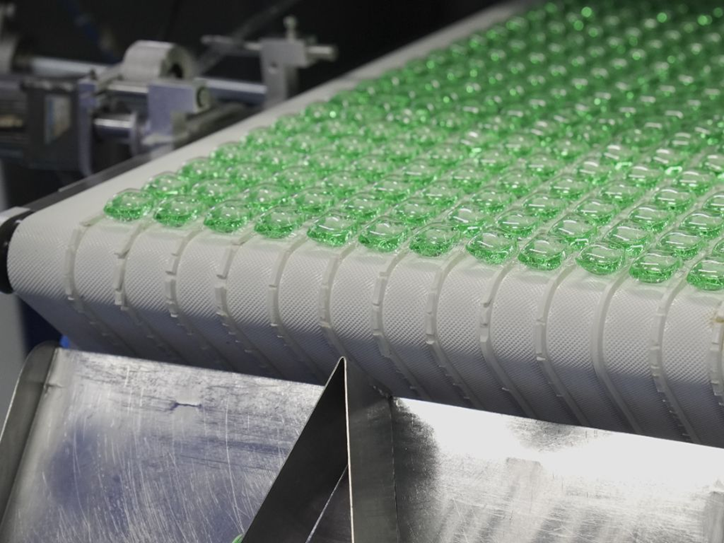
Using form-fill-seal technology, the equipment creates cavities in the PVA film and fills them with a precise amount of detergent.
Depending on the product design, manufacturers can produce:
- Single-chamber laundry pods
- Dual-chamber laundry detergent pods
- Multi-chamber laundry detergent capsules
Multi-chamber designs allow different ingredients to remain separated until the wash cycle begins.
Sealing and Forming
After filling, a second layer of water-soluble film is applied.
Heat and pressure create a strong seal around each capsule.
This stage is critical because even minor sealing defects can result in leakage during transportation or storage.
Modern laundry pods production lines use advanced sensors to monitor sealing quality in real time.
Drying and Stabilization
Freshly produced laundry detergent pods require stabilization before packaging.
Environmental conditions are carefully controlled to prevent deformation, sticking, or premature film dissolution.
This stage helps ensure consistent product appearance and long-term shelf stability.


Raw Materials Used in Laundry Pods
The performance of laundry detergent pods starts with carefully selected ingredients. Every component plays a specific role in cleaning efficiency, product stability, and consumer safety.
Active Cleaning Ingredients
The cleaning formula inside laundry pods typically contains:
- Surfactants for removing oils and dirt
- Enzymes for breaking down protein, starch, and grease stains
- Optical brighteners for improving fabric appearance
- Stain-fighting additives for targeted cleaning performance
Many modern laundry detergent pods are designed to work effectively in cold water, helping consumers reduce energy consumption without sacrificing cleaning results.
Stabilizers and Supporting Ingredients
Manufacturers also incorporate supporting ingredients to maintain product consistency.
They often use water softening agents to improve performance in hard water, pH regulators to maintain formula stability, anti-redeposition polymers to keep dirt from settling back onto fabrics, preservatives to protect the formula during storage, and foam control agents to ensure compatibility with different washing machines.
While consumers rarely notice these ingredients, they are critical for ensuring reliable performance across different water conditions and washing machine types.
Fragrances and Fabric Care Additives
Consumer preferences vary significantly by region.
In North America, stronger fragrances often remain popular, while European markets increasingly favor low-fragrance or fragrance-free options.
Additional fabric care ingredients may include:
- Color protection agents
- Anti-graying additives
- Fabric conditioning ingredients
- Odor-neutralizing technology
For OEM laundry pods manufacturers, fragrance customization is often one of the most requested private label options.
PVA Film: The Most Important Component
The outer shell of most laundry detergent pods is made from polyvinyl alcohol (PVA) film.
This material is one of the most critical factors affecting product performance.
A high-quality PVA film needs to dissolve quickly in water while remaining strong enough to withstand manufacturing, storage, and transportation.
Many production issues, including leaking capsules and incomplete dissolution, can often be traced back to poor film quality or improper storage conditions.
For this reason, leading laundry pods manufacturers invest heavily in film selection and testing.

Equipment Used to Produce Laundry Pods
Many buyers underestimate the sophistication of modern laundry detergent pod manufacturing facilities. Rather than a single machine, production relies on a fully integrated system where each stage ensures dosing accuracy, film stability, and sealing integrity.
In a typical OEM production line, the process flows through several connected systems:
Raw material handling and preparation
Raw material storage systems and automated feeding units ensure consistent supply of liquid surfactants, enzymes, and other active ingredients used in formulation.
Mixing and formulation control
Automated mixing tanks precisely blend ingredients under controlled temperature and viscosity conditions to maintain batch consistency.
Pod forming and encapsulation
Form-fill-seal machines work together with PVA film feeding systems to accurately dose liquid into water-soluble film and create sealed pods at high speed.
Quality control and inspection
Vision inspection systems and checkweighers detect defects such as sealing issues, underfilled pods, or irregular shapes in real time.
Final packaging automation
Automated packaging equipment groups, counts, and packs finished pods for shipment with minimal manual intervention.
For high-volume OEM production, this level of automation significantly improves throughput, product uniformity, and safety while reducing dependency on manual labor

Common Manufacturing Challenges
Producing laundry detergent pods at scale presents several technical challenges.
Leakage During Transportation
One of the most common quality issues is capsule leakage during storage and transportation.
Typical causes include:
- Weak sealing
- Film incompatibility
- Excessive filling volume
- Temperature fluctuations during shipping
To reduce this risk, experienced manufacturers often conduct compression testing, drop testing, and transportation simulations before large-scale production.
Humidity Control
Moisture is one of the biggest challenges in laundry pods production. Excess humidity can gradually weaken PVA film strength, cause capsules to stick together, and increase deformation rates during storage. In severe cases, it may also shorten the product's shelf life.
For this reason, many manufacturers operate climate-controlled production environments where temperature and humidity are continuously monitored to maintain product consistency.
Formula and Film Compatibility
Formula compatibility is another critical consideration. Not every detergent formulation performs well with every type of PVA film. Certain solvents, highly concentrated surfactants, or other aggressive ingredients may gradually affect film integrity, leading to leakage or reduced storage stability over time.
Before commercial production begins, manufacturers typically carry out compatibility testing to verify that both the detergent formula and film can maintain performance throughout the intended shelf life.
How Laundry Detergent Pods Are Tested for Quality
Quality assurance is a critical part of commercial production. Before shipment, manufacturers typically perform a series of tests to ensure product safety, performance, and consistency.
Dissolution Testing
Laundry detergent pods are tested under different washing conditions to confirm complete film dissolution and proper detergent release.
Common testing conditions include:
- Cold water cycles
- Warm water cycles
- High-efficiency machines
- Standard washing machines
Leakage Testing
Pressure, compression, and drop tests help identify weak seals before products reach consumers. These evaluations are designed to simulate handling and transportation conditions that pods may encounter throughout the supply chain.
Weight and Dosage Verification
Automated inspection systems verify that every laundry detergent pod contains the correct amount of detergent. Consistent dosing helps ensure reliable cleaning performance and is one of the key advantages of pods compared with traditional liquid or powder detergents.
Stability Testing
Manufacturers also conduct stability testing to evaluate how products perform during long-term storage. These assessments help determine expected shelf life while monitoring factors such as fragrance retention, film durability, and overall formula stability under different environmental conditions.


OEM and Private Label Laundry Pods Manufacturing
Many retailers and emerging brands choose OEM production instead of building their own manufacturing facilities. Partnering with an experienced laundry pods manufacturer allows brands to enter the market more quickly while avoiding the significant investment required for equipment, facilities, and production management.
Key advantages of OEM and private label manufacturing include:
- Lower investment costs
- Faster product development
- Flexible formula customization
- Custom fragrance options
- Private label packaging
- Regulatory support
However, selecting the right manufacturing partner is just as important as choosing the right product. Buyers should carefully assess factors such as production capacity, quality certifications, research and development capabilities, packaging flexibility, export experience, and lead times. These factors can directly influence product quality, supply stability, and speed to market.
A reliable manufacturing partner can help brands launch products more efficiently while maintaining consistent quality and supporting long-term business growth.

Sustainability Trends in Laundry Pods Production
Environmental concerns are reshaping laundry pods production, pushing manufacturers toward more system-level sustainability improvements.
Key directions include increased use of plant-based ingredients, reduced-plastic or hybrid packaging, concentrated formulas that lower material and transport demand, and lower-energy production processes. At the same time, ongoing advances in water-soluble film technology are improving dissolution performance and overall usability.
Overall, the focus is shifting from isolated improvements to full lifecycle optimization, aiming to reduce environmental impact while maintaining cleaning efficiency. As regulations tighten and expectations rise, sustainability is becoming a core competitive factor in the industry.
Conclusion
The production of laundry pods involves much more than simply filling detergent into a capsule. From ingredient formulation and PVA film technology to encapsulation, quality testing, and sustainable development, every stage affects product performance and consumer satisfaction.
For consumers, understanding how laundry detergent pods are produced helps explain their convenience and effectiveness. For brands and distributors, it highlights the importance of choosing an experienced laundry pods manufacturer with strong technical capabilities, quality control systems, and OEM customization expertise.
As the industry continues to evolve, innovation in materials, manufacturing technology, and sustainability will shape the next generation of laundry detergent pods.